
Introduction
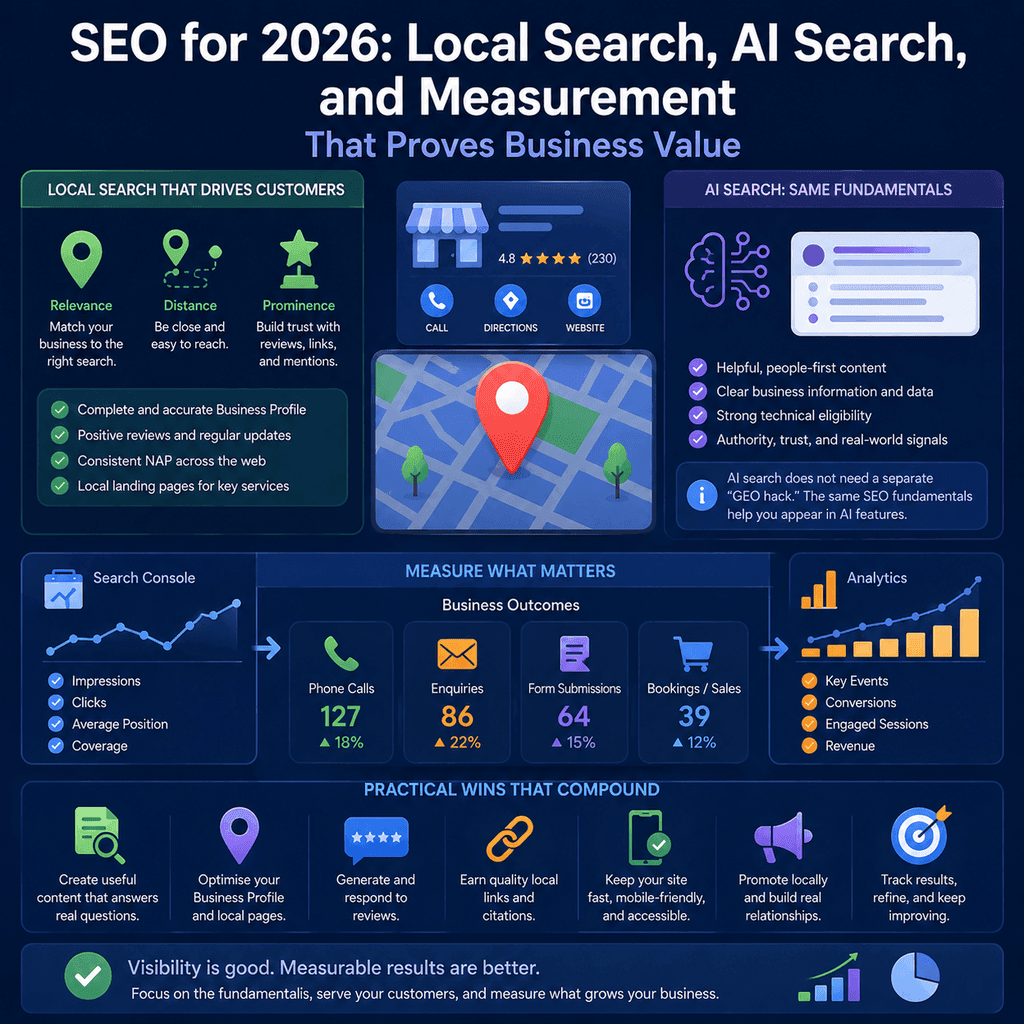
SEO in 2026 is not about chasing every new label that appears in marketing conversations. It is about helping the right people find the right business, understand why it is relevant, and take a useful action.
For many small businesses, that means being visible when people search locally, presenting clear and trustworthy business information, publishing genuinely useful pages, and measuring whether search visibility leads to enquiries, calls, bookings, sales, or other outcomes that matter.
AI search features have changed how some results are presented, but they have not removed the fundamentals. A business still needs a technically accessible website, helpful content, accurate business information, clear service and location signals, and a way to measure what search traffic does after someone finds the business.
This guide brings those pieces together. It covers local search, Google Business Profile, reviews, local landing pages, AI search visibility, Search Console, Analytics, leads, enquiries, phone calls, and how to judge SEO by business value rather than surface-level vanity metrics.
Introduction
SEO should support business decisions, not distract from them.
That matters because SEO advice often becomes fragmented. One conversation focuses on Google Business Profile. Another focuses on AI search. Another focuses on rankings. Another focuses on analytics. Treated separately, these can feel like different projects. In practice, they are connected.
A local service business needs to answer a few practical questions:
- Can search engines find and understand the website?
- Can Google understand what the business does, where it operates, and who it serves?
- Do the website and Business Profile give customers accurate information?
- Do the pages answer the questions people ask before they enquire?
- Are reviews and reputation signals being managed honestly?
- Can the business measure calls, forms, bookings, messages, and qualified leads?
- Is SEO being judged by real outcomes rather than impressions alone?
These questions are more useful than asking whether a business needs a separate “AI SEO”, “AEO”, or “GEO” strategy. Google’s own guidance says foundational SEO remains relevant for generative AI features, and that separate special optimisation is not required for features such as AI Overviews or AI Mode. See Google’s guidance on AI features and your website and its guide to optimising for generative AI features on Google Search.
The strategic conclusion is simple: do the fundamentals well, make the business easier to understand, and measure whether the work creates value.
What SEO Should Mean for a Small Business in 2026
For a small business, SEO should not mean trying to rank for every possible keyword. It should mean making the business visible for relevant searches that can reasonably lead to trust, contact, enquiry, booking, or purchase.
That includes classic organic results, local pack visibility, Google Maps visibility, Business Profile interactions, image and video visibility where relevant, and visibility in AI-assisted search experiences when Google’s systems decide a page or business is a useful supporting source.
The important word is relevant. More visibility is not automatically better if it attracts people who are not in the right area, not looking for the service, or not likely to become a useful customer.
A better SEO strategy is built around three layers:
- Eligibility: the website and business information can be found, crawled, indexed, understood, and trusted enough to be considered.
- Usefulness: the pages and profile answer real customer questions clearly and accurately.
- Measurement: the business can see whether search activity contributes to leads, calls, enquiries, bookings, sales, or other meaningful outcomes.
If one of those layers is missing, SEO becomes fragile. A useful page cannot perform if it cannot be indexed. A well-indexed page may not convert if the information is vague. A page that generates enquiries may be undervalued if nobody measures the enquiries.
Local Search Starts with Clear Business Information
Local SEO is the part of SEO concerned with visibility for searches connected to a place, service area, or nearby need.
For example, a person may search for a web designer in their town, an emergency plumber nearby, a physiotherapist within travelling distance, or a restaurant open tonight. In those cases, search engines need to understand both the searcher’s need and the business’s location, service area, category, reputation, and suitability.
Google explains local ranking using three main factors: relevance, distance, and prominence. Relevance is how well a Business Profile matches what someone is searching for. Distance is how far each business is from the searcher or searched location. Prominence is how well known the business appears to be, including signals such as reviews and information across the web. See Google’s guide to improving local ranking on Google.
That does not mean a business can control every local result. Distance is partly outside the business’s control. Competition varies by area. Google does not provide a way to request or pay for better organic local ranking. But a business can still improve the information and experience that Google and customers rely on.
Google Business Profile Is a Core Local Asset
A Google Business Profile is often one of the most visible local search assets a business has. It can appear in Google Search and Maps, and it can show important details before a person visits the website.
For local businesses, the profile should not be treated as a one-time setup task. It should be maintained as part of normal business operations.
Important profile information includes:
- business name;
- primary category and relevant additional categories;
- address or service area, depending on business type;
- phone number;
- website link;
- opening hours and special hours;
- services or products;
- business description;
- photos where useful;
- booking, messaging, or appointment options where appropriate.
Google’s Business Profile help explains that verified businesses can edit details such as address, hours, contact information, and photos to keep information accurate and up to date. See Google’s guide to editing a Business Profile.
Accuracy matters. If opening hours are wrong, a customer may arrive when the business is closed. If the service area is unclear, the business may receive unsuitable enquiries. If the website link goes to a weak or generic page, the profile may create clicks that do not convert.
Relevance, Distance, and Prominence in Plain English
Relevance, distance, and prominence are useful because they keep local SEO grounded.
Relevance
Relevance means the business matches the search. A business that offers WordPress maintenance should make that clear in its Business Profile, service pages, headings, body copy, internal links, and relevant metadata. A vague website that only says “digital solutions” gives weaker information to both users and search systems.
To improve relevance, make the business easy to classify. Use accurate service names. Explain who the service is for. Avoid stuffing every possible keyword into a page or profile. The goal is clarity, not repetition.
Distance
Distance means location matters. A searcher looking for a nearby service may see different results from someone in another town. A business cannot fake proximity to every location, and it should not create misleading location pages for places it does not genuinely serve.
For service-area businesses, be clear about the areas served. For businesses with a physical premises, keep the address accurate. For hybrid businesses, make the distinction between visitable location and service area clear.
Prominence
Prominence means the business appears well known or credible enough to be considered. Reviews, ratings, links, mentions, directories, local coverage, and the general strength of the business’s web presence can contribute to how prominent a business appears.
Prominence should be built honestly. Fake reviews, artificial mentions, and low-quality link schemes create risk and do not build a reliable business asset.
Reviews Affect Trust Before the Click
Reviews are not only an SEO signal. They are a customer decision signal.
A searcher may compare several businesses before clicking anything. They may look at review volume, rating, recency, owner replies, and the substance of what customers say. A business with thoughtful, specific reviews may look more credible than a business with a thin or neglected profile.
Google’s local ranking guidance says that more reviews and positive ratings can help local ranking. But the practical value of reviews goes beyond ranking. Reviews help people judge whether the business is reliable, responsive, suitable, and worth contacting.
A good review process should be simple and ethical:
- ask genuine customers for honest feedback;
- make the review process easy to understand;
- do not offer incentives for positive reviews;
- reply professionally to reviews where appropriate;
- learn from repeated complaints or praise;
- report reviews only when they violate platform policies.
Google provides guidance on how businesses can read and reply to reviews. Replies should be calm, specific, and professional. A good reply is written for the reviewer, but it is also read by future customers.
Local Landing Pages Should Help Real Customers
A local landing page is a page designed to explain a service, product, or business offering in relation to a place or service area.
Good local landing pages are useful. Weak local landing pages are often just doorway-style pages with the town name swapped out. That approach rarely creates value for users.
A useful local landing page should answer practical questions:
- What service is available in this area?
- Who is the service for?
- What problems does it solve?
- What is included?
- How does the process work?
- Can the business genuinely serve this location?
- What proof, examples, reviews, or experience support the claim?
- What should the visitor do next?
For a business with one location, a single strong service page may be better than many weak location pages. For a business that genuinely serves multiple towns, location pages can be useful if each page contains information that matters to customers in that area.
Do not create location pages simply because a keyword tool lists a town. Create them when the page can honestly help someone in that place make a decision.
Business Profile and Website Pages Should Agree
The website and Business Profile should describe the same business clearly.
Problems occur when the Business Profile says one thing and the website says another. For example, the profile may list one service area, while the website suggests national coverage. The profile may list emergency services, while the website gives no emergency contact route. The profile may use one business category, while the website’s service pages are vague.
Check consistency across:
- business name;
- address or service area;
- phone number;
- opening hours;
- services;
- booking links;
- contact routes;
- areas served;
- page titles and headings;
- schema or structured data where used.
Google’s LocalBusiness structured data documentation explains that structured data can tell Google about business details such as hours and departments where appropriate. Structured data should support accurate visible content; it should not be used to claim information that the page does not genuinely show. See Google’s documentation on Local Business structured data.
AI Search Does Not Need a Separate “GEO Hack” Strategy
AI search has changed how some search results are presented, but it has not created a separate shortcut around SEO fundamentals.
Google’s documentation for AI features in Search says that the best practices for SEO remain relevant for AI features such as AI Overviews and AI Mode, with no additional technical requirements beyond being indexed and eligible to appear in Google Search with a snippet. Google’s generative AI optimisation guide also states that, from Google Search’s perspective, optimising for generative AI search is still SEO.
That means businesses should be cautious about advice that sells “GEO hacks” as if AI visibility is a completely separate discipline. Some AI-related recommendations are simply renamed SEO fundamentals. Others are speculative or unsupported.
For a small business, the sensible AI search strategy is:
- make important pages crawlable and indexable;
- publish helpful, specific, non-generic content;
- make business details clear and consistent;
- support content with useful images or video where relevant;
- maintain Google Business Profile information;
- avoid producing large volumes of thin pages for search variations;
- measure outcomes rather than chasing every AI visibility screenshot.
AI systems can surface links, business information, and supporting pages in different ways, but they still depend on accessible, useful, trustworthy information. The best response is not panic. It is clarity.
What Visibility in AI Search Can Look Like
AI-assisted search features may summarise information, answer complex questions, provide links for further exploration, and help people explore topics differently from a classic list of blue links.
For a local or service business, visibility may appear indirectly. A page may be linked as a supporting source. A business may appear through local or business information. A guide, service page, product page, image, or video may support part of a broader answer. A user may arrive with a more specific question because an AI feature helped them refine what they need.
This makes measurement more important, not less important. If search behaviour changes, businesses need to understand whether qualified people still reach the site and whether those people take meaningful actions.
Do not judge AI search only by whether you personally see your brand in one test query. Results can vary by query, location, personal context, device, and search system changes. A better approach is to monitor the wider pattern: organic search clicks, landing pages, lead quality, Business Profile interactions, phone calls, form fills, and enquiries.
Search Console Shows Search Visibility Before the Visit
Google Search Console helps you understand how the website performs in Google Search before someone reaches the site.
Its performance data can show impressions, clicks, queries, pages, countries, devices, and other search-related information. Google’s Search Console guidance describes the Performance report as a way to monitor traffic from Google Search and break it down by queries, pages, and countries. See Google’s guide on how to use Search Console.
For a small business, useful Search Console questions include:
- Which pages receive impressions?
- Which pages receive clicks?
- Which queries are connected to service or location intent?
- Are important service pages getting discovered?
- Are impressions growing but clicks weak?
- Are clicks arriving on pages that can convert?
- Has a redesign changed performance for important pages?
- Are there indexing problems that affect key pages?
Search Console is not a full business reporting tool. It does not tell you whether a visitor phoned, submitted a form, or became a customer. It shows search visibility and search traffic signals. Those signals need to be connected to on-site behaviour and business outcomes.
Google Analytics Shows What Happens After the Visit
Google Analytics helps you understand what visitors do after they reach the website.
Google’s own guidance explains that Search Console focuses on activity before someone arrives from Google Search, while Google Analytics focuses on visitor interactions on the website, such as pages visited, time spent, actions taken, and traffic sources. See Google’s guide to using Search Console and Google Analytics data for SEO.
For SEO measurement, Analytics can help answer questions such as:
- Which landing pages attract organic visitors?
- Which pages lead to form submissions?
- Which traffic channels produce enquiries?
- Do users move from guide pages to service pages?
- Are mobile users completing contact actions?
- Which pages appear to attract traffic but not business value?
Analytics data is not perfect. Consent settings, tracking configuration, ad blockers, attribution models, and user behaviour can all affect reporting. The goal is not perfect certainty. The goal is a practical, consistent view of whether search activity contributes to business outcomes.
Measure Leads, Enquiries, and Phone Calls
SEO reporting often fails when it stops at rankings, impressions, or clicks.
Those metrics are useful, but they are not the final outcome for most businesses. A service business usually cares about enquiries, calls, consultations, bookings, quote requests, sales opportunities, and completed work.
Examples of meaningful SEO outcomes include:
- contact form submissions;
- quote requests;
- appointment bookings;
- phone calls from website click-to-call buttons;
- phone calls from Google Business Profile;
- email link clicks;
- newsletter signups where they support the sales process;
- checkout completions for ecommerce sites;
- qualified leads recorded in a CRM;
- new customers attributed to organic search or local search.
Google Analytics uses events to measure interactions, and key events are used for actions that are particularly important to the success of the business. Google explains that any collected event can become a key event if it measures an important action. See Google’s guidance on key events in Google Analytics.
For a small business website, common key events may include form submissions, phone link clicks, booking starts, booking completions, quote requests, and important contact actions.
Business Profile Performance Also Matters
Not every local search action happens on the website.
A customer may call directly from the Business Profile, click through to the website, request directions, send a message, view products, or make a booking. That activity can be part of SEO value even if it does not appear as an organic website session in Analytics.
Google’s Business Profile performance documentation describes metrics such as calls, website clicks, messages, bookings, booking clicks, and product views. See Google’s guide to Business Profile performance and insights.
This creates an important reporting point: local SEO should not be judged only by website traffic. If profile calls or website clicks increase, that can be meaningful. If those actions are poor quality, that should also be investigated.
A useful local SEO report should separate:
- website organic search performance;
- Business Profile interactions;
- phone calls and call quality where trackable;
- form enquiries and enquiry quality;
- bookings or sales;
- visible trends in local rankings and map presence where monitored.
The aim is to understand the whole path from search visibility to customer action.
Rankings Are Useful, but They Are Not the Whole Report
Ranking reports can be helpful, especially for priority services and locations. They can show whether visibility is improving for important search themes.
But rankings have limitations. Local results vary by searcher location. Search results can differ by device, query wording, personalisation, and result type. AI-assisted features can change how users interact with the page. A single keyword position does not show whether the business received useful enquiries.
Use rankings as one diagnostic signal, not as the whole strategy.
A better SEO reporting structure includes:
- visibility: impressions, local presence, rankings for priority themes;
- traffic: organic clicks and sessions;
- engagement: useful page journeys, service page visits, contact page visits;
- actions: calls, forms, bookings, messages, quote requests;
- quality: lead relevance, close rate, revenue, or customer fit where known;
- diagnostics: indexing, technical issues, content gaps, profile accuracy, review trends.
This keeps SEO connected to business value while still preserving enough detail to diagnose problems.
Build a Simple SEO Measurement Plan
A measurement plan defines what will be tracked and why.
It does not need to be complicated. For many small businesses, a simple plan is more useful than a complex dashboard nobody reads.
Start by identifying the business outcomes that matter. Then connect each outcome to a measurable action.
| Business question | Useful measurement | Tool or source |
|---|---|---|
| Are people finding us in Google Search? | Impressions, clicks, queries, landing pages. | Search Console. |
| Are organic visitors reaching useful pages? | Organic sessions and landing page activity. | Google Analytics. |
| Are visitors contacting us? | Form submissions, phone clicks, email clicks, bookings. | Google Analytics events and key events. |
| Are local searchers interacting with the profile? | Calls, website clicks, messages, bookings. | Business Profile performance. |
| Are leads useful? | Lead quality, accepted jobs, sales, revenue, customer fit. | CRM, call notes, booking system, manual tracking. |
This table is not a full analytics implementation. It is a decision framework. It helps the business avoid vague reports and focus on the evidence that affects decisions.
Lead Quality Matters More Than Lead Count Alone
More leads are not always better.
A business may increase enquiries but attract people outside the service area, people looking for a different service, or people with budgets that do not match the offer. That may look successful in a dashboard while creating operational waste.
Lead quality can be assessed with simple categories:
- relevant service and location;
- real customer need;
- appropriate budget or project size;
- reasonable urgency;
- good fit for the business;
- converted into consultation, booking, sale, or retained customer.
Where possible, connect SEO reporting to a CRM, booking system, spreadsheet, or internal lead notes. Even a basic manual review of enquiries can reveal whether SEO is attracting the right audience.
This is especially important for local service businesses. Ten qualified enquiries may be more valuable than one hundred unsuitable form fills.
Content Should Match the Buying Journey
SEO content should not only answer informational searches. It should help people move from uncertainty to a decision.
Different pages can serve different stages:
- Awareness: guides that explain the problem or topic.
- Consideration: pages that compare options, explain process, and answer common questions.
- Decision: service pages, location pages, case studies, testimonials, pricing information, and contact routes.
- Trust: about pages, reviews, credentials, policies, examples, and guarantees where appropriate.
A common mistake is publishing guides but neglecting service pages. Another mistake is building sales pages but never answering the questions people ask before contacting a provider.
A strong SEO strategy connects both. Helpful articles can educate and build trust, while clear service and location pages help qualified visitors take the next step.
Do Not Let AI Content Make the Website Generic
AI tools can help with research, structure, editing, and drafting, but they can also produce generic content that sounds plausible while saying very little.
Google’s guidance on generative AI content says the focus should remain on helpful, reliable, people-first content and compliance with Search Essentials and spam policies. See Google’s guidance on using generative AI content on your website.
For a small business, the strongest content often comes from real experience:
- common customer questions;
- real project examples;
- specific service processes;
- local knowledge;
- pricing explanations where appropriate;
- before-and-after context;
- mistakes customers should avoid;
- how the business makes decisions or delivers the service.
That type of information is harder to replace with generic content. It also helps customers understand whether the business is the right fit.
Technical Eligibility Still Matters
Strategy does not remove the need for technical SEO.
If important pages are blocked, noindexed, duplicated, slow to render, missing from internal links, or hidden behind fragile JavaScript, the business may lose visibility before content quality or reputation can matter.
Google’s SEO Starter Guide explains that Search Essentials cover the important elements that make a website eligible to appear in Google Search, while SEO helps improve the site’s presence in Search. See Google’s SEO Starter Guide.
For this strategic stage, the key technical checks are:
- important pages can be crawled;
- important pages are indexable;
- internal links use real crawlable links;
- canonical tags point to the correct URLs;
- redirects preserve important old URLs;
- mobile pages contain the same important content as desktop pages;
- business details are visible and consistent;
- structured data, where used, matches visible page content;
- Search Console is monitored for indexing and performance issues.
Technical SEO is not glamorous, but it protects the foundation that local, content, and measurement work depend on.
A Practical 2026 SEO Strategy for Small Businesses
A practical SEO strategy should be boring in the right way. It should be clear, repeatable, and connected to outcomes.
Use this sequence.
Step One: Confirm the Business Foundation
- Clarify core services, products, locations, and service areas.
- Check the Google Business Profile for accuracy.
- Check contact details, opening hours, and service information.
- Make sure the website reflects the same information.
Step Two: Fix Technical Eligibility
- Confirm important pages are crawlable and indexable.
- Check redirects, canonicals, sitemaps, and mobile content parity.
- Resolve obvious Search Console indexing issues.
- Make contact and enquiry routes easy to use on mobile.
Step Three: Improve Core Pages
- Strengthen homepage clarity.
- Improve service pages with specific, useful information.
- Create local landing pages only where they genuinely help users.
- Add proof, examples, FAQs, process information, and calls to action where appropriate.
Step Four: Build Trust Signals
- Ask genuine customers for honest reviews.
- Reply professionally to reviews.
- Show credentials, case studies, examples, policies, or guarantees where relevant.
- Keep business information consistent across important platforms.
Step Five: Measure Business Outcomes
- Set up Search Console.
- Set up Analytics events and key events.
- Track form submissions, phone clicks, bookings, and other contact actions.
- Review Business Profile performance.
- Assess lead quality, not only lead volume.
Step Six: Improve Based on Evidence
- Update weak pages that attract impressions but few clicks.
- Improve pages that attract traffic but poor enquiries.
- Create content for real customer questions.
- Retire, merge, or redirect low-value pages where appropriate.
- Review performance after major website or search changes.
What Does Not Matter as Much as People Claim
Some SEO activities receive more attention than they deserve.
For most small businesses, these should not be priorities:
- creating special files purely for AI systems without evidence they are needed;
- rewriting every page just to sound like an AI answer;
- creating hundreds of thin pages for small keyword variations;
- tracking isolated rankings while ignoring leads;
- obsessing over meta descriptions as if they are direct ranking controls;
- using fake reviews or artificial reputation tactics;
- copying competitor pages without adding genuine business-specific value;
- publishing generic AI-written posts that do not help customers make decisions.
These activities can consume time without building a stronger business asset.
The better use of time is to improve technical access, publish useful pages, maintain accurate business information, earn genuine reputation signals, and measure whether search creates business value.
What to Review Each Month
SEO does not need daily panic. A monthly review is usually enough for many small businesses, with extra checks after launches, migrations, algorithm updates, or major content changes.
A useful monthly review might include:
- Search Console clicks, impressions, queries, and landing pages;
- indexing issues affecting important pages;
- Google Analytics organic traffic and key events;
- form submissions and phone click trends;
- Business Profile calls, website clicks, messages, and bookings;
- new reviews and review replies;
- lead quality and customer fit;
- service or location pages that need improvement;
- new customer questions that deserve content.
The review should lead to decisions. For example, a page with strong impressions but weak clicks may need a clearer title and description. A page with traffic but poor enquiries may need better qualification. A service page with no visibility may need stronger internal links, better content, or technical investigation.
Conclusion
SEO for 2026 should be practical, measurable, and grounded in fundamentals.
Local search still depends on clear business information, relevance, distance, prominence, reviews, useful pages, and trust. AI search features change how some information is presented, but they do not remove the need for technical eligibility, helpful content, accurate business details, and a strong user experience.
The businesses that benefit most from SEO are usually not the ones chasing every new acronym. They are the ones that make themselves easy to understand, easy to trust, easy to contact, and easy to measure.
The strategic question is therefore not “how do we hack SEO in 2026?”
The better question is: can the right customers find us, understand us, trust us, contact us, and become measurable business value?