
Introduction
Some SEO improvements are genuinely quick wins. Others are shortcuts that only look clever until search systems catch up with them.
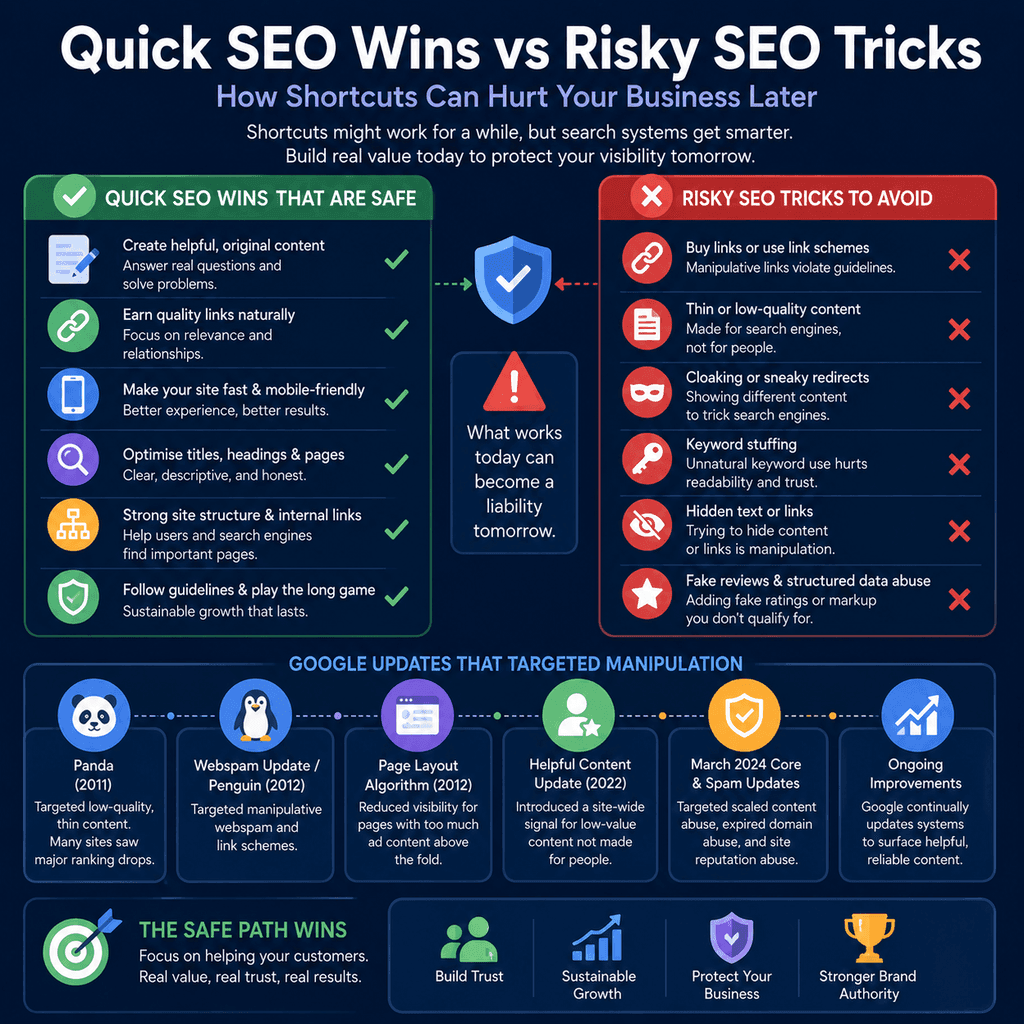
For a small business, the difference matters. A useful title rewrite, better internal links, clearer service pages, faster pages, and fixed indexing issues can improve a website without creating long-term risk. Buying manipulative links, publishing thin pages at scale, hiding text, stuffing pages with search terms, or using another site’s reputation to rank low-value content is a different category of activity.
The problem with risky SEO tricks is not only that they are against search engine guidance. It is that they can create fragile visibility. A tactic may appear to work for a while because it exploits a weakness, gap, or delay in search systems. When search systems or spam policies update, the same tactic can become the reason a site loses rankings, traffic, trust, or recoverability.
This guide explains the difference between practical SEO wins and risky shortcuts in plain English, using real examples from Google’s search quality and spam history.
What Counts as a Quick SEO Win?
A quick SEO win is an improvement that helps users and search engines understand the site more clearly, without deception or manipulation.
Examples include:
- writing clearer title elements and meta descriptions for important pages;
- making sure service pages explain what the business actually offers;
- linking important pages from the navigation, homepage, footer, or relevant content;
- fixing broken internal links;
- removing accidental
noindextags from pages that should appear in search; - making pages easier to crawl and understand;
- improving image sizes and page performance;
- adding helpful FAQs where users genuinely need answers;
- making contact details and service areas clearer;
- consolidating weak duplicate pages into stronger useful pages.
These are not magic tricks. They are basic quality and clarity improvements. They can still be quick, but they are quick because the site has obvious problems to fix, not because the work is trying to fool a search engine.
What Counts as a Risky SEO Trick?
A risky SEO trick is a tactic designed mainly to manipulate search visibility rather than help users.
Common examples include:
- buying or selling links intended to pass ranking signals;
- creating large numbers of near-duplicate location pages with little original value;
- publishing low-value articles at scale just to target search phrases;
- copying or lightly rewriting other websites’ content;
- hiding text or links from users while making them available to search engines;
- showing different content to search engines and human visitors;
- using expired domains mainly for their previous reputation;
- placing third-party content on a stronger site mainly to exploit that site’s reputation;
- filling the top of a page with ads or distractions before the actual content;
- promising searchers one thing in the title or snippet and delivering something else on the page.
Risky tactics often have a similar pattern. They try to create the appearance of relevance, authority, or usefulness without doing the work needed to earn it.
Why Shortcuts Can Work Temporarily
It is possible for a manipulative tactic to appear successful for a period of time.
Search systems are large, automated, and constantly changing. They have to evaluate huge numbers of pages, links, sites, templates, and patterns. That means some low-quality tactics may slip through temporarily, especially when they are new, when they exploit a weak signal, or when a site has not yet been re-evaluated.
That temporary success is what makes shortcuts tempting. Someone may see a competitor ranking with thin pages, spammy links, or mass-produced content and assume the tactic is safe. The better interpretation is more cautious: the tactic may simply not have been neutralised yet.
SEO should be judged by resilience, not only by whether something appears to work this month.
Google Search Essentials and Spam Policies
Google’s Search Essentials describe the basic requirements, spam policies, and best practices for appearing in Google Search. The important point for business owners is that Google separates helpful SEO from manipulative behaviour.
Google’s spam policies cover behaviours that can lead to lower rankings or removal from search results. These policies include practices such as cloaking, hidden text and link abuse, sneaky redirects, scaled content abuse, expired domain abuse, site reputation abuse, and other attempts to deceive users or manipulate search systems.
This does not mean every ranking drop is a penalty. Search results change for many reasons. Competitors improve. User intent shifts. Sites are re-evaluated. Technical issues appear. But when a site relies on tactics that violate spam policies, it is carrying avoidable risk.
Example One: Panda and Low-Quality Content
In 2011, Google discussed a major quality-focused algorithm change that became widely associated with the name Panda. Google described the work as an effort to help people find higher-quality sites in search results and later provided additional guidance for sites affected by the Panda change.
The practical lesson is still relevant: low-quality content can create site-level risk. A website with many pages that are thin, copied, low-value, poorly produced, or created mainly for search traffic may struggle even if some individual pages look acceptable in isolation.
For a small business website, this matters when someone suggests creating dozens or hundreds of pages that say almost the same thing with small keyword changes.
For example:
- “Web design in Town A”
- “Web design in Town B”
- “Web design in Town C”
- “Web design near Town D”
If each page has useful local information, genuine service relevance, and a clear reason to exist, location pages can be legitimate. If the pages are just copied text with the town name swapped, they are more likely to be thin doorway-style content than a useful resource.
Safe Alternative: Build Fewer, Stronger Pages
Instead of creating weak pages at scale, build pages that answer real questions.
A useful service page might explain:
- what the service includes;
- who it is for;
- what problems it solves;
- what the process looks like;
- what areas are served, where relevant;
- what makes the business credible;
- what the visitor should do next.
This is a safer quick win because it improves the page for both people and search engines.
Example Two: Webspam, Penguin, and Manipulative Links
In 2012, Google announced an algorithm change targeted at webspam. The update was later widely associated with Penguin and became strongly connected with manipulative link practices. Google’s later guidance around disavowing links also referred to situations where a site had built spammy or low-quality links that violated Google’s guidelines.
The business lesson is straightforward: links can matter, but manufactured links create risk.
Risky link tactics include:
- buying links that are intended to influence rankings;
- large-scale link exchanges;
- placing keyword-rich links in low-quality guest posts;
- using automated tools to create backlinks;
- adding links to unrelated directories, forums, comments, or widgets at scale;
- using private blog networks mainly to pass ranking signals.
These tactics are appealing because they try to shortcut reputation. Instead of earning visibility through useful pages, real relationships, credible mentions, and good business activity, they attempt to manufacture the appearance of authority.
Safe Alternative: Earn Links and Mentions Naturally
A safer approach is to give people legitimate reasons to mention or link to the business.
Examples include:
- publishing useful local guides or resources;
- creating genuinely helpful tutorials;
- earning coverage from real partners, suppliers, community organisations, or industry bodies;
- building useful tools, checklists, or examples that people want to reference;
- making sure business profiles and citations are accurate where they genuinely belong;
- being active in relevant communities without spamming them.
This is slower than buying a bundle of links. It is also much less fragile.
Example Three: Too Much Ad Content Above the Fold
Google’s 2012 page layout algorithm looked at how much useful content was visible when a user first landed on a page. Google explained that pages with little visible content above the fold, or pages that used a large amount of initial screen space for ads, could be affected.
The principle is simple: if users click a search result and have to scroll past adverts, popups, or clutter before finding the content they expected, that is a poor experience.
For small business websites, this does not only apply to display advertising. The same user-experience problem can appear when the top of a page is dominated by:
- oversized banners;
- generic hero sections with no useful information;
- intrusive popups;
- large stock photos that push the actual service information down;
- repetitive calls to action before the page explains the service;
- cookie banners or promotional overlays that make the page hard to use.
Safe Alternative: Put Useful Content Where Users Need It
A strong page should quickly confirm that the visitor is in the right place.
Near the top of an important page, make sure users can understand:
- what the page is about;
- what the business offers;
- whether the service or product is relevant to them;
- what the next sensible action is;
- where to find more detail if they need it.
Design still matters. The point is not to remove all visual polish. The point is to avoid design choices that hide the actual value of the page.
Example Four: The Helpful Content Update
In 2022, Google introduced what it described as a helpful content update. Google said the update introduced a site-wide signal used among other ranking signals, with systems identifying content that seemed to have little value, low-added value, or was otherwise not especially helpful to searchers.
This is important because unhelpful content can affect more than one page. If a site has a large amount of low-value content, stronger pages on the same site may also be less likely to perform as well as they otherwise could.
For business owners, the risky shortcut is publishing content simply because a keyword tool says people search for it. A topic having search volume does not automatically make it appropriate for your site.
Weak examples include:
- generic articles that repeat what every competitor already says;
- AI-generated pages published in bulk without expert review or original value;
- articles on trending topics unrelated to the business;
- thin comparison pages with no real experience or evidence;
- content written only to capture search visits, not to help the intended audience.
Safe Alternative: Publish for a Real Audience
Before publishing a page, ask whether it would still be worth creating if search traffic did not exist.
Useful content usually has a clear audience and purpose. It helps someone understand a decision, solve a problem, compare options, avoid a mistake, or take the next step with more confidence.
A good small business resource section does not need to cover every popular topic. It should cover the questions your customers actually have, using the knowledge your business can genuinely contribute.
Example Five: March 2024 Core and Spam Updates
In March 2024, Google announced a core update and new spam policies aimed at low-quality and manipulative practices. The announcement covered scaled content abuse, expired domain abuse, and site reputation abuse.
These policies are especially relevant because they address modern versions of old shortcuts.
Scaled Content Abuse
Scaled content abuse is the creation of many pages primarily to manipulate search rankings rather than help users. Google’s policy is not limited to one production method. The issue is the abusive purpose and low value, whether the content is produced by automation, humans, or a mixture of both.
For a small business, this means bulk publishing is not automatically a strategy. Creating hundreds of weak pages can become a liability.
Expired Domain Abuse
Expired domain abuse involves buying an expired domain and repurposing it mainly to benefit from its previous reputation while hosting low-value content.
There are legitimate reasons to buy or reuse an old domain. The risk appears when the main purpose is to manipulate rankings rather than build a new, useful site for people.
Site Reputation Abuse
Site reputation abuse involves publishing third-party pages on a site in an attempt to exploit that site’s ranking signals. This is sometimes called “parasite SEO” in the SEO industry, although Google’s policy language is more precise.
Not all third-party content is a violation. Freelance content, guest contributions, partner content, user-generated content, and affiliate content can be legitimate when they are properly controlled, relevant, and useful. The problem is publishing low-value third-party content mainly to borrow the host site’s reputation for ranking purposes.
Why “Everyone Else Is Doing It” Is Not a Good Risk Test
Many poor SEO decisions start with competitor copying.
A business owner sees another site ranking with questionable tactics and concludes that the same tactics must be safe. That conclusion is weak. You usually do not know:
- whether the competitor is actually benefiting from the tactic;
- whether they have stronger signals elsewhere that compensate for weak pages;
- whether the tactic has already stopped working and the results have not caught up yet;
- whether the site will be affected by a future update;
- whether they have already received warnings, manual actions, or declining traffic.
Competitor analysis is useful for understanding the market. It is not a guarantee that every visible tactic is safe, ethical, or durable.
Common Risky Promises from SEO Sellers
Be cautious when an SEO offer is built around guaranteed shortcuts.
Risk signals include:
- guaranteed first-page rankings for broad competitive terms;
- large numbers of backlinks for a fixed low price;
- hundreds of AI pages published without a clear quality process;
- secret networks of websites used to link to clients;
- promises to “trick the algorithm”;
- keyword stuffing in titles, footers, alt text, or hidden page areas;
- content copied from competitors and lightly rewritten;
- doorway pages created only to capture local searches;
- advice to ignore users because “Googlebot is all that matters”.
A credible SEO provider should be able to explain the work in normal language. If the explanation depends on secrecy, artificial scarcity, or fear, treat that as a warning sign.
What Safe SEO Looks Like in Practice
Safe SEO is not passive. It is still strategic, technical, and deliberate.
For a small business website, safe SEO often means:
- building pages around real services, products, locations, and customer needs;
- making important pages crawlable and indexable;
- using descriptive titles, headings, and internal links;
- answering practical questions clearly;
- showing genuine experience, evidence, and trust signals;
- keeping information accurate and current;
- improving speed and usability;
- fixing technical issues that block discovery, crawling, rendering, indexing, or understanding;
- earning mentions through real business activity;
- monitoring performance without panicking after every small ranking change.
This type of work is not as flashy as a shortcut. It is more defensible because it improves the website itself.
How to Judge an SEO Opportunity
Before using a tactic, ask a few blunt questions.
- Would this still make sense if search engines did not exist?
- Does this help a real visitor understand or trust the business?
- Is the page useful enough to deserve to exist?
- Are we creating something original, accurate, and specific?
- Would we be comfortable explaining this tactic publicly?
- Does this rely on hiding something from users or search engines?
- Does this create a pattern that looks manipulative at scale?
- Could this damage the business if a search quality update targets it?
If a tactic fails these questions, it is probably not a quick win. It is probably risk disguised as progress.
What to Do if You Have Used Risky SEO Before
Many businesses inherit poor SEO work. A previous provider may have built low-quality links, created doorway pages, published thin content, or added hidden text without the owner fully understanding the risk.
Start with an audit rather than panic.
Useful steps include:
- reviewing Search Console for manual actions, indexing issues, and major traffic changes;
- checking whether important pages are genuinely useful and up to date;
- identifying thin, duplicate, copied, or outdated pages;
- removing, consolidating, improving, or noindexing low-value pages where appropriate;
- reviewing backlink history if the site has paid for link building or received unnatural link warnings;
- removing spammy user-generated content;
- checking that redirects and canonical tags are not being used deceptively;
- documenting changes so recovery work can be measured properly.
Do not delete everything blindly. Some older pages may have useful links, rankings, or conversion value. The aim is to understand what helps users and what creates avoidable risk.
Quick Wins Worth Prioritising
If you want practical SEO improvement without gambling on tricks, start with the fundamentals.
- Improve important service pages: make them clearer, more specific, and more useful.
- Fix indexability mistakes: remove accidental
noindexrules from pages that should be searchable. - Improve internal links: link important pages from relevant pages using descriptive anchor text.
- Rewrite vague titles: make titles specific to each page.
- Clean up thin pages: improve, merge, remove, or noindex pages that do not help users.
- Check mobile pages: make sure mobile visitors get the same useful information as desktop visitors.
- Reduce friction: improve speed, layout, readability, and calls to action.
- Use Search Console: check whether Google can crawl, index, and understand important pages.
These are not loopholes. They are basic repairs and improvements. That is why they are safer.
Final Thoughts
The safest SEO strategy is not to avoid optimisation. It is to avoid manipulation.
Good SEO helps search engines discover and understand useful pages. Risky SEO tries to manufacture signals that the site has not earned. The first approach builds a stronger website. The second approach can create a temporary lift followed by a harder problem later.
For small businesses, the practical rule is simple: choose work that improves the website even if rankings take time. Clear content, crawlable pages, honest search appearance, useful internal links, sensible technical foundations, and a good user experience are not shortcuts. They are the foundation that survives better when search systems change.