
Introduction
Google’s guidance on helpful, reliable, people-first content is often reduced to a slogan. That is a mistake.
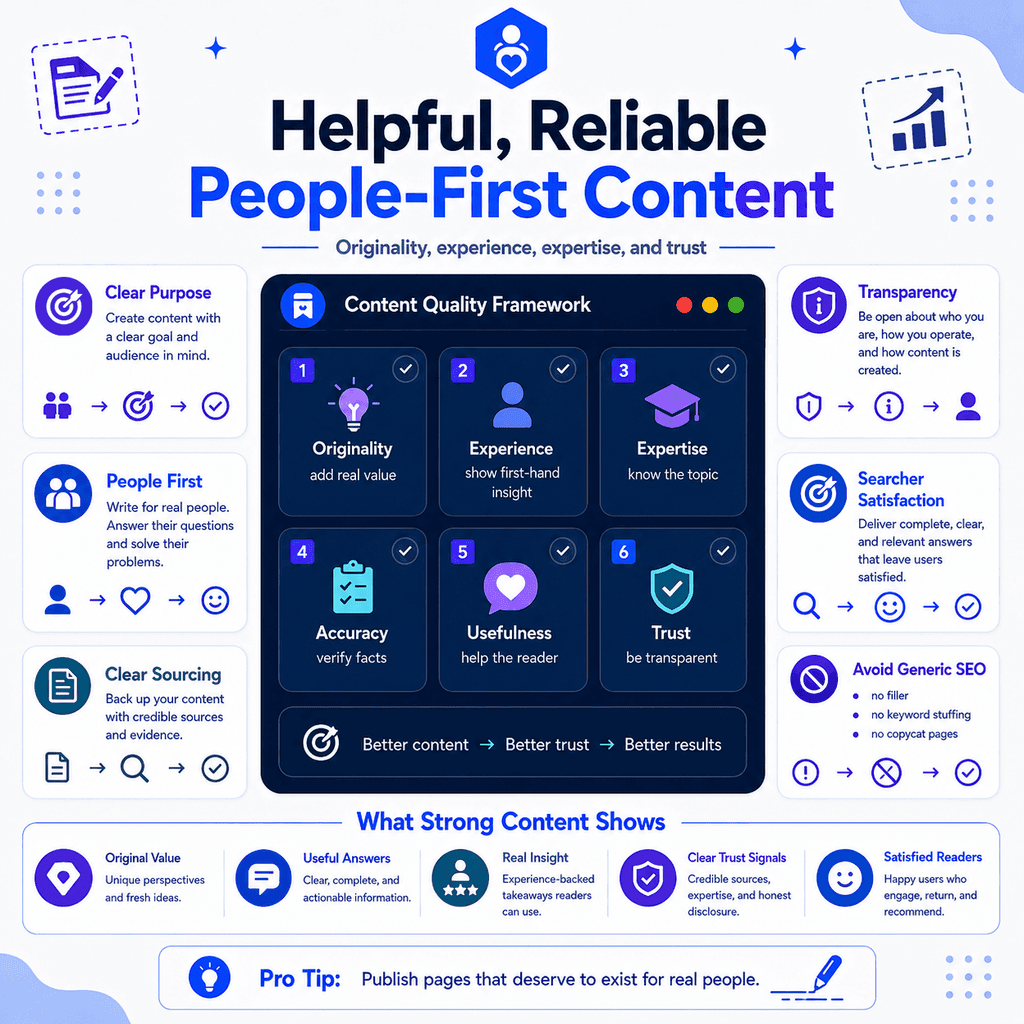
The guidance is not simply saying “write good content”. It is asking website owners, publishers, and businesses to examine whether a page exists to genuinely help people, whether it shows appropriate experience or expertise, whether it is accurate and trustworthy, and whether it leaves the searcher satisfied.
This matters because a lot of “SEO content” is still produced backwards. Someone finds a keyword, checks a word count, skims the current search results, rewrites the same points in a slightly different order, and publishes a page that adds little or nothing. That may look like content production, but it is not a serious quality strategy.
Google’s public guidance is much more demanding. Its page on creating helpful, reliable, people-first content asks whether content provides original information, substantial description, insightful analysis, clear sourcing, evidence of expertise, and a satisfying experience for the reader. It also warns against content made primarily to attract search visits, mass-produced content, extensive automation across many topics, superficial summaries of other sources, artificial word-count targets, and writing about topics without real expertise.
For small business owners, the practical lesson is direct: do not publish content just because a keyword tool says a phrase has searches. Publish content because your audience needs it, your business is qualified to speak about it, and the page helps someone complete a real task.
What “People-First Content” Means
People-first content is content created primarily for people, not primarily to manipulate search rankings.
That does not mean SEO is bad. Google’s own guidance says SEO can be helpful when it is applied to people-first content. The distinction is whether SEO supports a useful page or whether the page exists mainly as a search-traffic trap.
A people-first page usually has a clear audience and a clear job. It may help someone understand a service, compare options, solve a problem, make a decision, avoid a mistake, or complete a process.
A search-engine-first page usually has a different feel. It is often written to target a phrase rather than satisfy a need. It repeats familiar points without adding much value. It may be long without being useful. It may mention questions without answering them properly. It may leave the reader needing to search again.
For example, a people-first page about choosing a web designer might explain what affects cost, what questions to ask, what warning signs to look for, what deliverables to expect, and when a cheaper template-based option may be enough. A search-engine-first page might simply repeat “choose the best web designer” with generic advice that could apply to any service provider.
Content Needs a Purpose
Every page should have a purpose.
That sounds basic, but many weak SEO pages fail here. They exist because a keyword exists, not because the business has something useful to say.
A clear purpose answers questions such as:
- Who is this page for?
- What problem is the reader trying to solve?
- What should they understand by the end?
- What decision or action should the page support?
- Why is this website qualified to publish the page?
Purpose is not the same as a target keyword. A keyword can indicate demand, but it does not define the page’s job by itself. The page still needs to satisfy the reason behind the search.
For a small business, useful purposes might include explaining a service, answering a common customer question, comparing two options, clarifying a pricing factor, documenting a process, or helping a visitor decide whether the business is a good fit.
Originality Means More Than Different Words
Originality is one of the most important parts of content quality.
It does not always mean new scientific research or a never-before-seen idea. It means the page should contribute something real rather than simply copying, paraphrasing, or lightly rearranging what already exists.
Originality can come from:
- first-hand experience;
- specific examples;
- clear explanations based on professional knowledge;
- original analysis;
- real product or service experience;
- case-based observations;
- local knowledge;
- original photos, screenshots, data, or process descriptions;
- clearer organisation than competing pages;
- practical judgement that helps the reader decide what to do.
A page can be unoriginal even if every sentence is technically rewritten. If the page merely repackages the same obvious advice as every other result, it is unlikely to be a strong page.
For business content, originality often comes from being specific. Instead of writing a generic “benefits of regular website maintenance” article, a web company could explain what actually happens when maintenance is neglected: outdated plugins, broken forms, slow pages, security risk, compatibility problems, and missed backups. Specificity is usually more useful than generic positivity.
First-Hand Experience Matters
Google added “experience” to E-A-T to form E-E-A-T: experience, expertise, authoritativeness, and trustworthiness. Its Search Central blog explains that experience means content may demonstrate that it was produced with actual use, actual visits, or real lived experience, depending on the topic.
This is important because not every useful page needs the same kind of authority.
If the topic is tax filing, medical treatment, legal advice, or financial planning, formal expertise and careful sourcing may be essential. If the topic is a product review, a tutorial, a local guide, or a practical service comparison, first-hand experience may be a major part of what makes the content useful.
Experience can be shown through:
- describing what was actually tested or done;
- including original observations;
- showing relevant photos or screenshots where useful;
- explaining limitations and trade-offs;
- describing real processes rather than abstract claims;
- using examples from actual customer or project scenarios, without exposing private information.
Experience should not be faked. A review that has not used the product, a guide written by someone who has never done the task, or a service article that hides lack of knowledge behind generic wording is weak content.
Expertise Should Match the Topic
Expertise is not one-size-fits-all.
Some topics require professional qualifications, formal training, or regulated knowledge. Other topics may require practical experience, technical skill, or deep familiarity with a niche.
A small business does not need to pretend to be an academic institution. It does need to make clear why it is qualified to speak on the topic.
For example:
- An electrician can explain common causes of tripping circuits from practical field experience.
- A web designer can explain why a contact form might not convert well, using project experience.
- A solicitor writing about legal obligations should be appropriately qualified and careful.
- A product reviewer should have used or examined the product.
- A local service provider can contribute local context that national articles often miss.
Expertise should be visible. That may mean author information, business credentials, examples, case studies, methodology, clear explanations, links to supporting sources, or transparent limits on what the page does and does not cover.
Clear Sourcing Builds Trust
Clear sourcing is a practical trust signal.
When a page makes factual claims, especially about law, finance, health, safety, public policy, technical standards, or search engine guidance, the reader should be able to see where the information comes from.
Sourcing does not mean filling a page with academic-style footnotes. For a public-facing business article, it often means linking naturally to the original guidance, official documentation, standards body, regulator, or primary source when that helps the reader verify the claim.
Good sourcing looks like this:
- linking to Google Search Central when explaining Google’s own content guidance;
- linking to a government regulator for legal or compliance requirements;
- linking to a standards body for technical standards;
- linking to original research rather than a low-quality article summarising it;
- making clear when something is professional judgement rather than a settled fact.
Poor sourcing looks like this:
- copying claims from low-quality blogs without checking the original source;
- using vague phrases such as “studies show” without identifying any study;
- linking to sources that do not actually support the claim;
- using outdated advice because it is convenient;
- treating SEO rumours as facts.
For SEO content in 2026, unsupported confidence is a liability.
Accuracy Is a Content Quality Issue
Accuracy is not separate from SEO quality. It is part of quality.
A page that is engaging but factually wrong is not helpful. A page that is technically well-written but outdated can mislead the reader. A page that makes claims stronger than the evidence supports can damage trust.
Accuracy is especially important for topics where bad information can cause harm. This includes health, finance, legal issues, safety, employment, housing, major purchases, and technical implementation that could affect a business.
Practical accuracy checks include:
- checking the current primary source before publishing;
- avoiding claims that are broader than the evidence;
- updating content when policies, prices, laws, tools, or standards change;
- distinguishing facts from opinion;
- removing outdated advice rather than simply changing the publication date;
- having qualified people review sensitive content.
Google’s content guidance explicitly asks whether content has easily verified factual errors. That is a direct reminder: if a claim is easy to verify, it is also easy for poor content to be exposed.
Usefulness Means Satisfying the Task
Helpful content should help the searcher complete the task that brought them to the page.
That task may be informational, commercial, navigational, or practical. Someone might want to understand a concept, choose between options, troubleshoot a problem, compare providers, prepare for a call, or decide whether to buy.
A useful page does not merely mention the topic. It moves the reader forward.
For example, if the page is about “how much does a small business website cost?”, a useful answer might cover:
- the main price ranges;
- what changes the cost;
- what is usually included;
- what is often excluded;
- when a cheaper option may be enough;
- when a custom build is justified;
- what questions to ask before paying;
- what ongoing costs to expect.
A weak answer might say “it depends” for 800 words and never explain what it depends on.
Usefulness is not the same as length. A concise page can satisfy a simple task. A detailed guide may be needed for a complex task. The right depth depends on the searcher’s need.
Transparency Helps Readers Judge the Page
Transparency means the reader can understand who is behind the content, why it exists, and how to judge it.
For a business website, transparency can include:
- a clear About page;
- contact details;
- author or reviewer information where relevant;
- dates for content that changes over time;
- clear explanations of commercial relationships;
- honest descriptions of methods, experience, and limitations;
- visible policies for privacy, returns, complaints, or service terms where relevant.
Transparency is especially important when content influences a decision involving money, safety, wellbeing, or trust.
It is also important for affiliate, review, and comparison content. Readers should not have to guess whether recommendations are based on testing, commercial relationships, or automated summaries.
What E-E-A-T Actually Means
E-E-A-T stands for experience, expertise, authoritativeness, and trustworthiness.
It is useful as a quality framework. It is not a simple public numeric score that you can optimise by adding a few labels to a page.
Google’s Search Central documentation explains that its systems use many factors to identify content that seems helpful, and that those factors can help determine whether content demonstrates aspects of E-E-A-T. It also says trust is the most important of these aspects, with experience, expertise, and authoritativeness contributing to trust.
This is a practical way to think about E-E-A-T:
- Experience: does the content show real involvement with the topic?
- Expertise: does the creator have the knowledge needed for this topic?
- Authoritativeness: is the creator, business, or site recognised or credible in this area?
- Trustworthiness: can the reader rely on the page, the source, and the site?
Different topics need different mixes. A restaurant review may benefit from first-hand experience. A medical explanation needs appropriate expertise and careful sourcing. A local service page may need real business identity, proof of work, location clarity, reviews, and accurate service information.
E-E-A-T Is Not a Checklist You Can Fake
Because E-E-A-T is often discussed in SEO, it is easy to turn it into a superficial checklist.
Weak interpretations include:
- adding a fake author bio;
- adding “expert reviewed” without a real review process;
- listing credentials that are not relevant to the topic;
- adding generic trust badges;
- creating an About page that says nothing specific;
- using AI-generated author photos or fictional experts;
- copying citations without understanding them.
These are not serious quality improvements.
Better E-E-A-T work is usually more substantive:
- assigning topics to people with relevant knowledge;
- reviewing sensitive content before publication;
- showing real experience where it matters;
- linking to primary sources;
- correcting outdated or inaccurate pages;
- making business identity and contact information clear;
- publishing content that fits the site’s actual purpose.
In other words, E-E-A-T is not something to decorate a page with after the fact. It should shape what gets published and how the page is built.
Quality Rater Guidelines Are Not the Algorithm
Google’s Search Quality Rater Guidelines are often misunderstood.
Search quality raters help Google evaluate the performance of its search systems. Google has stated that rater guidelines do not directly influence ranking. They are still useful because they show the kinds of qualities Google wants its systems to reward.
That distinction matters.
You should not read the rater guidelines as a list of direct ranking factors. You should read them as a quality model. They help explain what good search results should look like from a human evaluation perspective.
For content creators, the practical lesson is to use E-E-A-T and people-first guidance to self-assess content quality, not to chase a made-up “E-E-A-T score”.
Reject Generic Keyword-Led SEO Content
Generic keyword-led SEO content is content built around phrases rather than people.
It usually has these traits:
- the topic was chosen only because a keyword tool showed volume;
- the content repeats what already ranks without adding value;
- the writer has no real experience or expertise in the topic;
- the page avoids specifics because specifics require knowledge;
- the content uses a familiar template across many topics;
- the page is padded to hit a perceived word count;
- the reader leaves needing a better source.
This kind of content is weak because it misunderstands SEO. The goal is not to publish something that resembles a search result. The goal is to publish the page that the searcher actually needed.
Keyword research can still be useful. It can reveal language, demand, questions, and patterns. But it should inform content decisions, not replace editorial judgement.
Good SEO Content Still Uses SEO
People-first content does not mean ignoring search.
Good SEO still helps a useful page become easier to find and understand.
Practical SEO work can include:
- choosing a clear page title;
- using headings that describe the page structure;
- matching the page to a real search need;
- using internal links to related pages;
- writing descriptive URLs;
- using image alt text where appropriate;
- making the page crawlable and indexable;
- checking Search Console data;
- improving page experience and mobile usability.
This is not manipulative when the page itself is useful. It is basic communication.
Google’s SEO Starter Guide frames SEO as helping search engines understand content and helping users find a site. That is the right relationship: SEO should support the reader’s experience, not replace it.
Content Quality Starts Before Writing
Many content problems begin before the first paragraph is written.
Before creating a page, answer these questions:
- Who is the intended reader?
- What task are they trying to complete?
- What would make the page genuinely useful?
- What experience or expertise can we bring?
- What primary sources should be checked?
- What claims need evidence?
- What would competing pages fail to explain well?
- What action or next step should be clear?
This prevents the page from becoming a generic content exercise.
If you cannot answer these questions, the page may not be ready to write.
How to Show First-Hand Experience
First-hand experience should be visible in the content itself.
Depending on the topic, you might show it by including:
- what you tested;
- what you observed;
- what went wrong;
- what changed your judgement;
- what examples came from real projects;
- what limitations you found;
- what screenshots, photos, or data support the explanation;
- what practical trade-offs a novice should know.
For example, a guide to choosing website hosting is stronger if it explains real performance, support, backup, security, and migration considerations from project experience. It is weaker if it simply lists “fast, secure, reliable” because those words appear in every hosting article.
Do not invent experience. If the business does not have real experience with a topic, either assign the content to someone who does or choose a topic the business can cover responsibly.
How to Show Expertise Without Making the Page Dense
Expert content does not need to be hard to read.
For small business audiences, expertise is often most valuable when it makes a complex topic simpler.
Good expert writing:
- uses plain English without becoming vague;
- defines technical terms when needed;
- explains why something matters;
- shows trade-offs;
- states uncertainty where appropriate;
- does not overclaim;
- links to primary sources for important claims;
- gives practical next steps.
Expertise is not shown by jargon alone. In many cases, jargon can hide weak thinking. A knowledgeable writer can usually explain the issue clearly enough for the intended audience without distorting the facts.
How to Use Sources Well
Sources should support the content, not decorate it.
Use primary sources wherever possible. For SEO topics, that often means Google Search Central documentation, official search engine guidance, standards documentation, or original research when a research claim is being made.
When using a source, check:
- Who published it?
- Is it primary or secondary?
- Is it current enough for the claim?
- Does it actually support the sentence being written?
- Is the topic time-sensitive?
- Are there conflicts, limitations, or context that should be mentioned?
Do not cite a source you have not read. Do not cite a source for a stronger claim than it supports. Do not rely on old SEO blog posts for claims about current search systems unless the point is historical and clearly labelled as such.
How to Keep Content Accurate Over Time
Publishing is not the end of quality control.
Some pages age quickly. A guide about search policy, platform features, legal requirements, pricing, software, accessibility standards, or technical implementation may need scheduled review.
Practical maintenance includes:
- reviewing important pages periodically;
- checking whether linked sources have changed;
- updating screenshots or examples when interfaces change;
- removing obsolete recommendations;
- recording meaningful update dates only when the content actually changes;
- watching Search Console data for changes in queries and performance;
- refreshing pages that no longer satisfy the searcher’s task.
Changing a date without improving the content is not a quality update. Google’s people-first guidance specifically warns against changing dates to make pages seem fresh when the content has not substantially changed.
How to Judge Whether a Page Satisfies the Searcher
A page satisfies the searcher when it gives them enough useful information to move forward.
That does not always mean answering every possible question. It means matching the task.
Useful checks include:
- Can the reader understand the answer without needing another source immediately?
- Does the page address the main reason someone would search this topic?
- Does it include the important caveats?
- Does it avoid padding and repetition?
- Does it make the next step clear?
- Does it explain who the advice is and is not for?
- Does it show why the publisher is qualified to help?
If the reader reaches the end and still has to search again because the page avoided the useful details, the page has not done its job.
Thin Content Is Not Always Short Content
Thin content is not simply content with a low word count.
A short answer can be excellent if the question is simple. A long article can be thin if it repeats obvious points and adds no real value.
Thin content often has these traits:
- little original information;
- no evidence of experience or expertise;
- generic claims;
- no useful examples;
- shallow coverage of the real task;
- unverified factual claims;
- content padded to look comprehensive;
- no clear audience or purpose.
Instead of asking “how long should this article be?”, ask “what does the reader need to complete the task?”
Google’s content guidance explicitly rejects the idea that there is a preferred word count for ranking. Length should follow usefulness.
AI-Generated Content Needs the Same Quality Standard
Google’s guidance on AI-generated content focuses on quality and purpose, not simply on whether a human or a machine produced the first draft. Its Search Central guidance says using automation, including AI, to generate content primarily to manipulate rankings is against spam policies. The underlying issue is whether the content is helpful, reliable, and people-first.
That means AI-assisted content still needs editorial responsibility.
Before publishing AI-assisted content, check:
- Are the facts verified?
- Does the page add original value?
- Is there real expertise behind it?
- Are claims sourced properly?
- Is the content appropriate for the site’s purpose?
- Has a qualified person reviewed it where needed?
- Would the page still deserve to exist if search traffic did not?
AI can help with drafting, structure, editing, and summarising notes. It should not be used as a substitute for expertise, evidence, or accountability.
Mass-Produced Content Is a Warning Sign
Mass production can harm quality when pages receive little care or exist mainly to capture search traffic.
Google’s helpful content guidance asks whether content is mass-produced or spread across many sites so that individual pages do not receive much attention or care. Its spam policies also address scaled content abuse, where many pages are generated primarily to manipulate search rankings rather than help users.
For small businesses, the lesson is not that publishing regularly is bad. The lesson is that scale without care is risky.
Publishing ten strong pages that answer real customer questions is usually better than publishing one hundred shallow posts that add nothing.
Content Should Fit the Site’s Primary Purpose
A website should have a primary purpose or focus.
If a local accounting firm suddenly publishes hundreds of unrelated articles about celebrity news, fitness products, and gaming guides, that creates a quality problem. The content does not fit the site’s purpose or audience.
Google’s guidance warns against producing content on many different topics in the hope that some of it performs in search. That is not a sustainable content strategy.
For a business website, strong content usually supports the business’s real area of expertise:
- services the business provides;
- questions customers ask before buying;
- problems the business solves;
- industry knowledge the business can explain responsibly;
- case studies and examples from real work;
- guides that help the intended audience make better decisions.
Stay close to the audience and the site’s actual purpose.
Page Experience Still Matters
Useful content is easier to trust and use when the page experience is good.
Google’s helpful content guidance says its core ranking systems look to reward content that provides a good page experience and advises site owners not to focus on only one or two aspects. In practical terms, the page should be accessible, readable, fast enough, stable, and usable on real devices.
Content quality can be weakened by page problems such as:
- intrusive popups covering the answer;
- slow loading;
- poor mobile layout;
- low contrast text;
- unclear navigation;
- ads or calls to action that overwhelm the main content;
- forms or buttons that are difficult to use;
- pages that shift around while loading.
A helpful article hidden behind a frustrating interface is not a fully helpful experience.
Titles and Headings Should Be Descriptive
Titles and headings should help readers understand the page.
A good title is specific and accurate. It does not exaggerate, shock, or promise more than the page delivers.
Good headings make the structure easier to scan. They should tell the reader what each section covers.
A weak heading might say “The Secret Nobody Tells You”. A stronger heading might say “Why Word Count Is Not a Quality Target”.
This matters for both people and search engines. Clear page structure helps users scan, helps assistive technologies navigate, and helps search systems understand the content.
Trust Signals Should Be Real
Trust signals only help if they correspond to something real.
Useful trust signals may include:
- clear business identity;
- accurate contact details;
- relevant credentials;
- real author or reviewer information;
- case studies;
- reviews;
- portfolio examples;
- transparent policies;
- clear sourcing;
- corrections or update notes where appropriate.
Weak trust signals include generic badges, vague claims, fake urgency, copied awards, stock author profiles, and unsupported “expert” labels.
Trust is built through consistency between what the page says, who says it, what evidence supports it, and how the site behaves.
A Practical Content Quality Checklist
Use this checklist before publishing important content.
- Does the page have a clear audience?
- Does it have a clear purpose?
- Does it satisfy a real searcher task?
- Does it provide original value?
- Does it show first-hand experience where relevant?
- Does it show appropriate expertise?
- Are factual claims accurate and current?
- Are important claims supported by reliable sources?
- Is the publisher or author transparent enough for the topic?
- Does the page avoid generic keyword-led padding?
- Does it make the next step clear?
- Is the page usable on mobile?
- Are links, forms, and calls to action clear?
- Would this page still deserve to exist without search traffic?
If the answer to several of these questions is no, the page needs more work.
What to Improve on an Existing Weak Page
When a page is underperforming, do not start by asking which keyword to add.
Start by diagnosing the page’s weakness.
Common improvements include:
- clarifying the page purpose;
- rewriting the introduction so it answers the real question faster;
- adding examples from real experience;
- removing padded sections;
- adding missing caveats;
- linking to primary sources;
- updating outdated claims;
- adding author or business context;
- improving headings;
- adding internal links to related useful pages;
- making the page easier to read on mobile;
- improving calls to action.
The goal is not to make the page look more like other search results. The goal is to make it more useful than it was.
When Not to Publish
Sometimes the best content decision is not to publish.
Do not publish a page if:
- the business has no real knowledge of the topic;
- the page cannot add anything useful;
- the content is based on unverified claims;
- the topic is sensitive and no qualified review is available;
- the page exists only to chase a trend;
- the reader would be better served by an official source that you cannot improve on;
- the page would dilute the site’s purpose.
Publishing less can be a quality decision. A smaller site with accurate, focused, useful content is often stronger than a larger site filled with shallow pages.
How This Applies to Small Business Websites
Small business content does not need to imitate a national publisher.
It should answer the questions real customers ask.
Strong small business content often includes:
- clear service pages;
- pricing explanations where possible;
- process explanations;
- local information where relevant;
- case studies or examples;
- comparisons between common options;
- maintenance and aftercare advice;
- answers to objections or concerns;
- proof of experience and credibility.
This kind of content is useful because it is grounded in actual business knowledge. It also helps search because it makes the site more understandable and more relevant to real queries.
Best Practices
Create content for a real audience, not just for a keyword list.
Define the page purpose before writing.
Use keyword research to understand language and demand, not to justify generic pages.
Add original value through experience, examples, analysis, clarity, or specific expertise.
Use reliable primary sources for factual claims.
Show who is behind the content where that affects trust.
Keep content accurate and update it when facts change.
Use E-E-A-T as a quality framework, not as a fake score.
Do not hide lack of expertise behind generic writing.
Do not mass-produce pages that receive little care.
Make the page easy to read, navigate, and use.
Ask whether the reader can complete their task after reading the page.
Quick Summary
Helpful, reliable, people-first content is content created primarily to help people complete a real task.
Google’s guidance emphasises originality, substantial value, clear sourcing, evidence of expertise, first-hand experience, accuracy, usefulness, page experience, and trust.
E-E-A-T stands for experience, expertise, authoritativeness, and trustworthiness. It is a useful quality framework, not a public numeric ranking score that can be gamed with superficial labels.
Generic keyword-led SEO content is weak because it often adds little value and leaves the reader needing a better answer.
Good SEO still matters, but it should support useful content by making it easier to discover, understand, navigate, and measure.
The practical standard is simple: publish pages that deserve to exist for your audience, not pages that only exist because a keyword was found.