
Introduction
SEO stands for search engine optimisation.
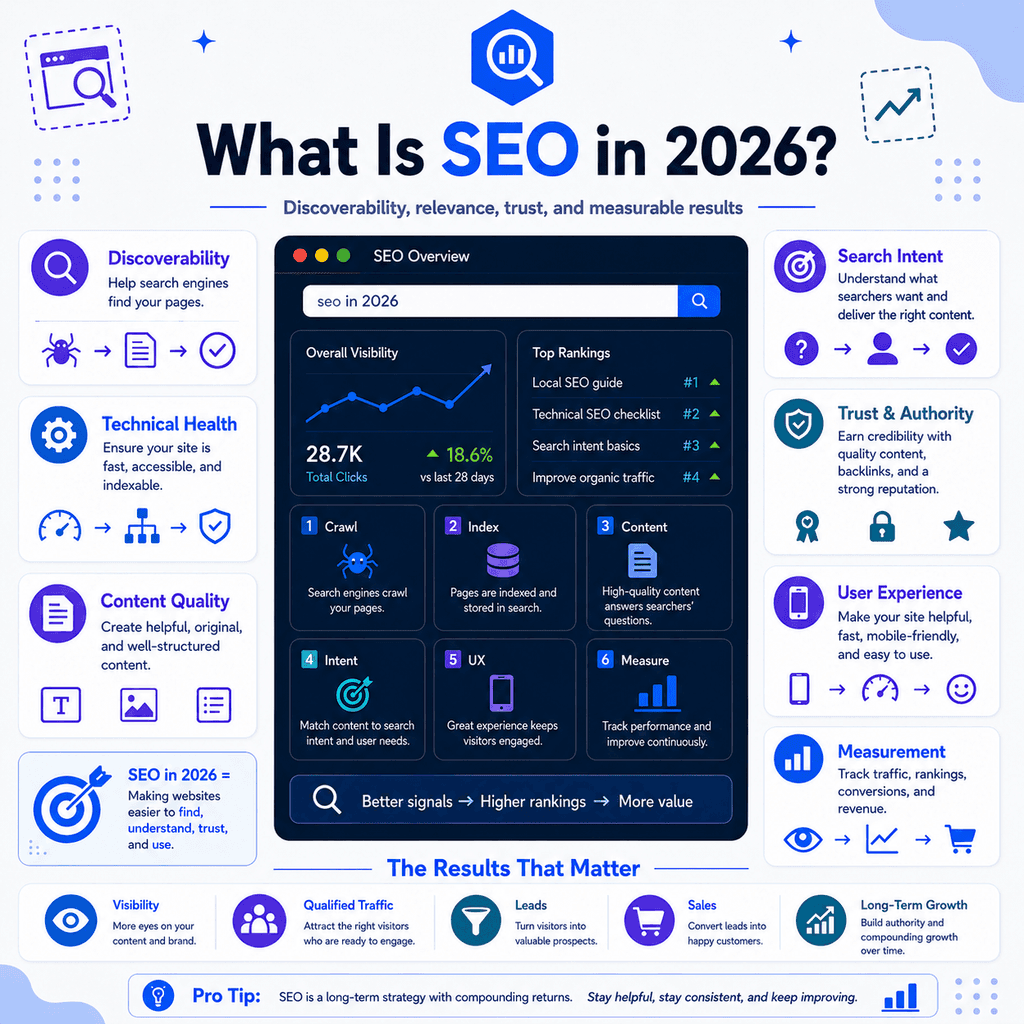
In plain English, SEO is the work of improving a website so that people and search engines can more easily find it, understand its content, trust it, and use it. It focuses on organic search, which means the non-paid results shown on search engines such as Google, Bing, and DuckDuckGo. SEO also includes measuring how well that organic search visibility and traffic are performing.
That definition matters because SEO is often described badly. It is not a bag of loopholes, keyword tricks, or secret settings that force a website to the top of Google. Modern SEO is more practical than that. It is the discipline of improving the things that help a search engine find a page, understand what it is about, judge whether it is useful for a searcher, and show it in a way that helps the right people decide whether to visit.
For a small business, that can mean being found when someone searches for a local service. For an online shop, it can mean product pages that are clear enough to qualify for relevant searches. For a professional service website, it can mean publishing explanations that answer the questions potential clients are already asking.
In 2026, SEO still matters because people still use search to solve problems, compare options, research services, and make decisions. Search results have changed. AI features, richer results, maps, images, videos, shopping results, and answer-style interfaces have made search more varied. But the underlying requirement remains: your website needs to be technically eligible, understandable, useful, and measurable.
SEO in One Sentence
SEO is the ongoing work of helping the right pages appear for the right searches, in a way that is useful to people and measurable for the business.
That sentence contains several important ideas.
“The right pages” means SEO is not only about the homepage. A service page, location page, product page, guide, case study, category page, or help article may each serve a different search need.
“The right searches” means SEO is not about chasing traffic for its own sake. A thousand irrelevant visits are usually less valuable than ten visits from people who need what the business offers.
“Useful to people” means content and pages must help the visitor do something: understand, compare, decide, book, buy, contact, learn, or solve a problem.
“Measurable for the business” means SEO should connect to evidence. Rankings can be useful, but they are not the whole story. Impressions, clicks, enquiries, sales, booked calls, qualified leads, assisted conversions, and content engagement all help show whether organic search is doing useful work.
What SEO Is Not
SEO is not a shortcut around having a useful website.
It is not keyword stuffing. It is not hiding text. It is not buying random links. It is not rewriting the same article hundreds of times. It is not publishing content only because a keyword tool found a search phrase. It is not changing dates on old pages to make them look fresh when the substance has not changed.
Search engines have become better at evaluating pages in context. That does not mean they are perfect, and it does not mean every good page automatically performs well. But it does mean weak, manipulative, or purely search-engine-first tactics are a poor foundation.
Good SEO is closer to product improvement than trickery. It asks practical questions:
- Can search engines access the page?
- Can they understand what the page is about?
- Does the page satisfy a real search need?
- Is the content original, accurate, and useful?
- Is the page easy to use on real devices?
- Is the business measuring the right outcomes?
How Search Works at a Basic Level
Google describes Search as involving three broad stages: crawling, indexing, and serving results. Crawling is the process of discovering and fetching pages. Indexing is the process of analysing and storing information from those pages. Serving is the process of returning results that are relevant to a user’s query. You can read Google’s overview in its guide to how Search works.
This matters because SEO problems can happen at any stage.
If a page cannot be crawled, search engines may not find it properly. If a page can be crawled but not indexed, it cannot appear as a normal organic result. If a page is indexed but not considered useful or relevant for a query, it may appear poorly or not at all. If a result appears but the title, snippet, offer, or page experience is weak, people may choose something else.
SEO therefore includes technical work, content work, user experience work, and measurement work. Reducing it to “adding keywords” misses most of the discipline.
The below is a useful video from Google discussing how how Google Search works.
Discoverability: Can Search Engines Find the Site?
The first job of SEO is discoverability.
A website can only earn organic visibility if search engines can find its important pages. Search engines usually discover pages through links. They may also use sitemaps, feeds, submitted URLs, and other signals, but internal and external links remain important because they show that pages exist and how they relate to one another.
For a small business website, discoverability often starts with basic hygiene:
- Important pages are linked from the navigation or relevant internal pages.
- Service pages are not hidden several layers deep with no clear route to them.
- URLs are stable and descriptive.
- The site has an XML sitemap where appropriate.
- The site is not accidentally blocking important pages with robots.txt or noindex rules.
- Pages return the correct status codes.
Google’s SEO Starter Guide explains that SEO helps search engines understand content and helps users find a site through search. That is a useful framing: discoverability is not only technical; it is also about helping people and crawlers move through the site logically.
Eligibility: Can the Page Appear in Search?
Eligibility is the baseline. A page needs to meet basic technical requirements before it can perform in search.
This does not mean every small business needs a complex technical SEO audit every month. Many websites pass the basics without realising it. But the basics still matter because one wrong setting can remove a page from search.
Common eligibility issues include:
- The page is blocked from crawling.
- The page uses a noindex directive.
- The page redirects somewhere unexpected.
- The canonical tag points to the wrong URL.
- The server returns an error.
- The page requires a login but is intended to be public.
- Important content depends on resources that search engines cannot access.
Google’s Search Essentials describe the core parts of what makes web content eligible to appear and perform in Google Search: technical requirements, spam policies, and key best practices. Eligibility does not guarantee visibility, but without it the rest of SEO has little to work with.
Understanding: Can Search Engines and People Understand the Page?
Search engines need to understand what a page is about. People need the same thing.
This is where page structure matters. A clear title, useful headings, descriptive body copy, meaningful internal links, image alt text where appropriate, and structured data where relevant can all help a page communicate its purpose.
A well-structured service page, for example, should make the basics obvious:
- What service is being offered?
- Who is it for?
- Where is it available?
- What problems does it solve?
- What makes the business credible?
- What should the visitor do next?
Understanding is not the same as keyword repetition. A page about emergency plumbing does not become better by repeating “emergency plumber” in every paragraph. It becomes better when it clearly answers the questions someone might have in that situation: availability, location, response process, common problems, pricing expectations, proof of competence, and how to get help.
Relevance: Does the Page Match the Search Need?
Relevance is about the relationship between the searcher’s query and the page.
Someone searching “how to choose a web designer” is probably researching. Someone searching “web designer near me” may be closer to choosing a provider. Someone searching “WordPress maintenance pricing” likely wants costs, packages, or comparisons. These are different needs.
Evidence-based SEO does not treat every keyword as a page to be created. It asks what kind of page would genuinely satisfy the search need.
For example:
- A broad educational query may need a guide.
- A local service query may need a service page with location signals.
- A product comparison query may need a comparison page.
- A brand query may need a clear homepage or about page.
- A support query may need a help article.
The job is not to trick the search engine into thinking a page is relevant. The job is to make the page actually relevant, then make that relevance clear.
Usefulness: Does the Page Help the Visitor?
Modern SEO is inseparable from usefulness.
Google’s guidance on helpful, reliable, people-first content says content should be created primarily for people rather than to manipulate search rankings. That is not just a moral point. It is a practical SEO point.
A useful page gives the visitor enough information to move forward. It does not hide the answer behind vague copy. It does not make the visitor search again because the page avoids the important details. It does not promise an answer and then deliver a thin summary of what every other website already says.
For a small business, useful content often means being specific:
- Describe the service in concrete terms.
- Explain who the service is suitable for.
- Answer common objections and questions.
- Show evidence of real experience.
- Use examples where they help.
- Make next steps clear.
Useful content does not need to be long for the sake of length. A short page can be excellent if it fully answers a simple need. A long page can be poor if it is padded, repetitive, or unfocused.
Trust: Why Should Someone Believe the Page?
Trust is central to SEO because searchers are making decisions with consequences. Some decisions are minor. Others involve money, health, safety, legal issues, or important life choices.
Trust can be supported in several practical ways:
- Clear business identity.
- Accurate contact information.
- Named authors or reviewers where relevant.
- Evidence of real experience.
- Transparent pricing or process information where possible.
- Customer reviews or case studies where appropriate.
- Clear policies for purchases, bookings, refunds, or privacy.
- Content that is kept accurate when facts change.
Google’s content guidance discusses experience, expertise, authoritativeness, and trustworthiness as concepts used to evaluate content quality. For website owners, the practical lesson is straightforward: do not expect anonymous, generic, unsupported content to carry the same weight as content that clearly shows who it is from, why it exists, and why it can be trusted.
Page Experience: Can People Use the Site Comfortably?
SEO does not end when someone clicks a result. The page still has to work.
Page experience includes whether the site loads reliably, works on mobile, avoids intrusive interruptions, keeps content readable, and lets people complete the task they came for. A technically indexed page can still underperform if people find it slow, confusing, cramped, or difficult to use.
For small business websites, the most common problems are often simple:
- Pages are difficult to read on mobile.
- Navigation is unclear.
- Contact details are hard to find.
- Buttons are too small.
- Forms are too long or confusing.
- Important content is buried below vague marketing copy.
- Images are oversized and slow.
- Pop-ups block the main task.
Search visibility is more valuable when the landing page turns visitors into enquiries, bookings, purchases, or informed next steps. That is why SEO and web design should not be treated as separate worlds.
Measurement: How Do You Know SEO Is Working?
Evidence-based SEO needs measurement.
That does not mean every business needs a complicated reporting system. It means SEO decisions should be connected to observable data rather than hunches.
Useful measurement sources can include:
- Google Search Console for organic impressions, clicks, queries, pages, indexing, and technical issues.
- Analytics data for engagement, conversions, landing pages, and user journeys.
- Call tracking or enquiry source tracking where appropriate.
- Rank tracking for selected important terms, used carefully.
- CRM or sales data showing whether organic enquiries become real customers.
Search Console is especially useful because it shows how a site appears in Google Search: which queries generate impressions, which pages receive clicks, and whether there are indexing or enhancement issues. For business decisions, though, clicks alone are not enough. A page that brings fewer visits but more qualified enquiries may be more valuable than a page that brings large numbers of low-intent visitors.
What Evidence-Based SEO Means
Evidence-based SEO means making decisions from reliable sources, observable data, and careful testing rather than rumours.
It combines three kinds of evidence.
First, use primary search engine documentation for baseline rules and concepts. This includes guidance on crawling, indexing, technical requirements, spam policies, structured data, page experience, and content quality.
Second, use your own site data. A local plumber, an ecommerce shop, and a legal practice will not have the same search behaviour, conversion paths, or content needs. Search Console and analytics data help show what is happening on the actual website.
Third, use controlled changes where possible. If you improve a service page, measure what changes over time. If you restructure internal links, watch whether important pages gain impressions. If you rewrite thin content, track whether the page attracts more relevant queries and better engagement.
Evidence-based SEO also means being honest about uncertainty. Search engines use complex systems. Nobody outside the search engines has a complete list of ranking calculations. Serious SEO avoids pretending that one checklist can guarantee rankings.
Why SEO Still Matters in 2026
SEO still matters because search remains a major way people discover businesses, compare options, and answer questions.
It also matters because organic search is often high-intent. Someone searching for a specific service, product, problem, or comparison is already expressing demand. The business does not have to interrupt them; it has to be findable and convincing when the search happens.
SEO also supports other marketing channels. A well-structured website helps paid search landing pages, social media referrals, email campaigns, sales conversations, and customer support. Clear service pages, useful guides, fast pages, strong calls to action, and measurable conversions are valuable beyond organic rankings.
In 2026, search is more complex than a traditional list of blue links. Some results are local, visual, video-led, AI-assisted, shopping-oriented, or heavily personalised by context. That does not make SEO irrelevant. It makes the fundamentals more important: clear pages, credible information, crawlable structure, useful content, and measurable outcomes.
What Small Businesses Often Get Wrong
Small businesses often underinvest in the basics while worrying about advanced tactics.
Common mistakes include:
- Having one vague “services” page instead of clear pages for distinct services.
- Using homepage copy that says very little about what the business actually does.
- Publishing blog posts that attract irrelevant visitors but do not support the business.
- Ignoring Search Console until traffic drops.
- Not tracking contact form submissions or calls.
- Using thin location pages with no useful local information.
- Letting old service descriptions become inaccurate.
- Making the site visually attractive but difficult to understand.
Most small businesses do not need secret SEO tricks. They need a website that clearly explains what they do, for whom, where, why it is credible, and how to take the next step. Then they need the technical and measurement foundations to make that work visible in search data.
What SEO Work Usually Includes
SEO work can be grouped into several practical areas.
Technical SEO deals with crawlability, indexability, site structure, status codes, redirects, canonicals, sitemaps, internal links, page speed, mobile usability, and structured data where relevant.
Content SEO deals with search intent, page purpose, headings, titles, body copy, useful explanations, originality, topical coverage, media, internal links, and content maintenance.
On-page SEO deals with how each page communicates its topic and value: title links, headings, snippets, URLs, image alt text, and clear calls to action.
Local SEO deals with location relevance, service area clarity, local landing pages, reviews, business profiles, local citations, and consistency of contact details.
Authority and reputation work deals with earning attention, mentions, links, reviews, and references from places that make sense for the business.
Measurement deals with Search Console, analytics, conversions, reporting, experiments, and decisions based on real outcomes.
These categories overlap. A page can be technically accessible but useless. It can be useful but hard to find. It can rank but fail to convert. Good SEO looks at the whole system.
SEO and AI Search
AI-assisted search has changed how some information is presented, but it has not removed the need for reliable web content.
Search systems still need sources to crawl, understand, evaluate, summarise, cite, or link to. A business website still needs clear pages that explain services, answer questions, show credibility, and give users a reason to act.
For practical SEO, this means content should be easy for both people and machines to understand. Use clear headings. Avoid vague claims. State facts plainly. Show who the content is for. Make important details explicit. Keep pages accurate. Link related pages logically.
Do not treat “AI SEO” as permission to produce generic content at scale. If anything, the value of distinct experience, clarity, original explanation, and trust signals becomes more important when search results contain more summaries and competing information formats.
A Simple SEO Framework for 2026
A useful way to think about SEO is through five questions.
First: can the page be discovered and indexed?
Second: can the page be understood?
Third: does the page match a real search need?
Fourth: is the page useful and trustworthy enough for the visitor?
Fifth: can the business measure whether the page is producing value?
If a page fails the first question, it has a technical problem. If it fails the second, it has a communication problem. If it fails the third, it has a targeting problem. If it fails the fourth, it has a quality or experience problem. If it fails the fifth, it has a measurement problem.
This framework keeps SEO grounded. It also prevents the common mistake of treating SEO as only one thing.
When SEO May Not Be the First Priority
SEO is important, but it is not always the first marketing priority.
If a business has no clear offer, no defined audience, no ability to handle enquiries, or no website that explains the basics, SEO cannot solve all of that by itself.
Likewise, SEO is usually not the fastest channel for immediate results. Search improvements can take time to be crawled, indexed, tested by users, and reflected in performance. For urgent campaigns, paid advertising, email, partnerships, direct outreach, or local networking may be faster.
That does not make SEO less valuable. It means SEO should be used for the right job. It is strongest as a long-term visibility and trust-building channel, especially when the website already supports clear business goals.
What to Do First
For a business starting with SEO, begin with the foundations.
- Make sure the website can be indexed.
- Set up Google Search Console.
- Identify the pages that should bring enquiries, sales, bookings, or qualified attention.
- Check that each important page has a clear purpose.
- Rewrite vague pages so they answer real customer questions.
- Improve internal links between related pages.
- Make the site usable on mobile.
- Track meaningful conversions, not only visits.
Do not start by chasing hundreds of keywords. Start by making the most important pages clearer, more useful, more technically sound, and easier to measure.
Best Practices
Build pages for real people and real search needs.
Make important pages crawlable, indexable, and internally linked.
Use clear titles, headings, URLs, and descriptive copy.
Explain services, products, pricing factors, locations, process, proof, and next steps where relevant.
Keep content accurate and update it when the underlying facts change.
Avoid manipulative tactics, low-value mass content, and keyword stuffing.
Use Search Console and analytics data to understand what is happening.
Measure outcomes that matter to the business.
Improve the website experience, not only the text on the page.
Treat SEO as an ongoing discipline, not a one-time plugin setting.
Quick Summary
SEO in 2026 is the practical work of making a website discoverable, understandable, useful, and measurable in organic search.
It is not a set of loopholes. It is a discipline that combines technical eligibility, search relevance, content quality, usability, trust, and business measurement.
Search engines need to crawl, index, and understand pages before those pages can appear for relevant searches.
People need pages that answer their questions, support decisions, and make next steps clear.
Businesses need evidence that organic search is producing value, not just impressions or vanity rankings.
SEO still matters because search still connects people with information, services, products, and decisions. The format of search results will keep changing, but the need for useful, accessible, trustworthy, well-structured websites has not gone away.